Showing posts with label native american pictographs. Show all posts

Friday, June 6, 2014

Native American Rock Art: Chimney Meadows, Lamont Meadows


Chimney Meadows.

Here are photos from two stops on an eventful day ranging from desolate deserts to mountain meadows. I went back to Jawbone Canyon and ruled out a hunch, and drove out to Walt Bickel's mining camp in the El Paso Range, but what I really wanted to see were a pair of rock art sites which can be accessed via the Chimney Peak Byway.

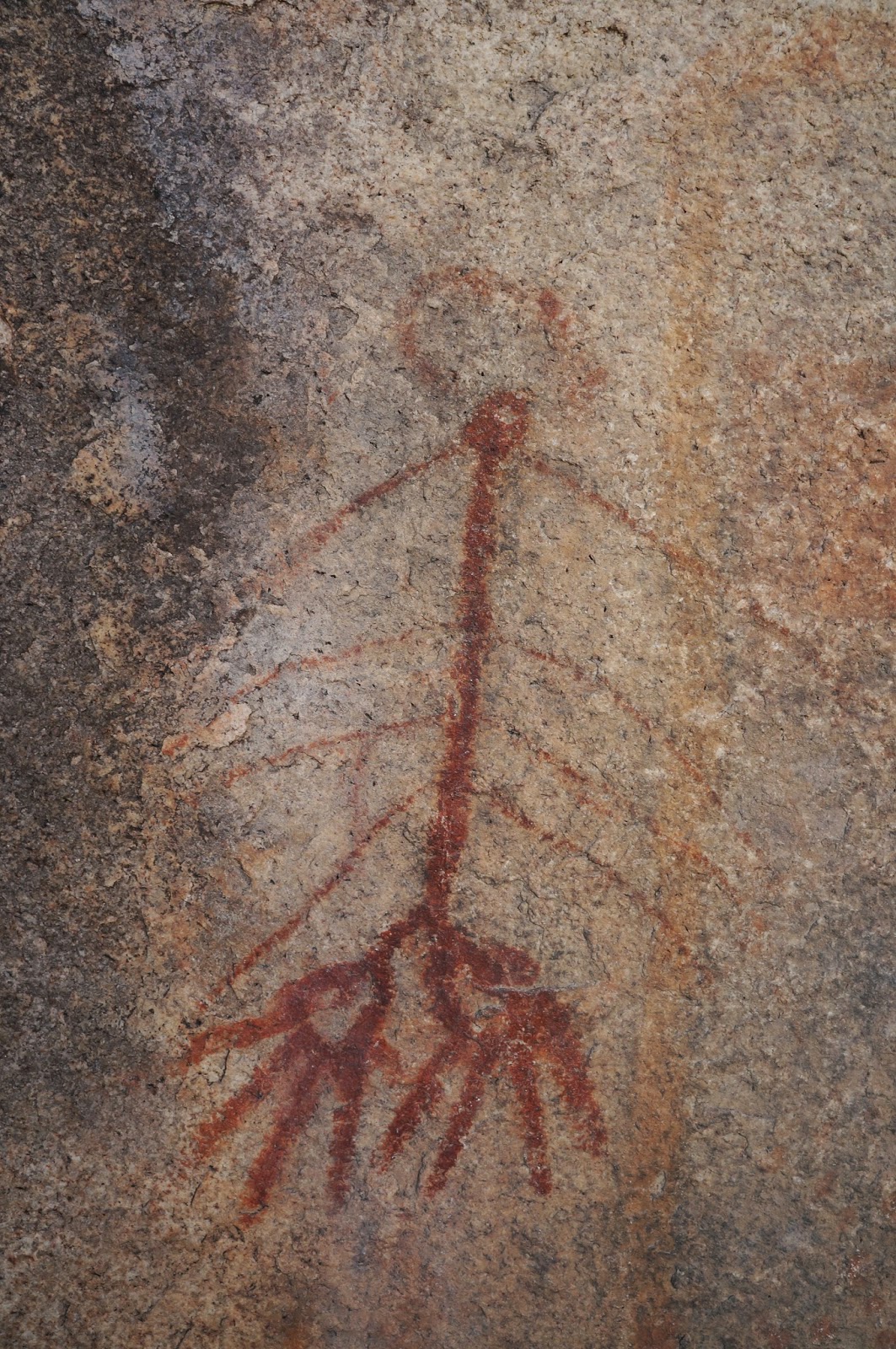
Hidden away near Chimney Meadows is a small rock art site. The paintings cling to the underside of a granite shelf which overhangs the paintings. The art is old and fading, much of it essentially gone. The photo below shows hints of a fading orange, though the other elements are strictly monochrome red. It's a neat site that offers deluxe views of the meadow and immediate access to Chimney Creek.

The second site is fairly well known. It is located in Lamont Meadows which lies below and downstream of Chimney Meadows. The art is displayed on the roof of a large granite overhang which is difficult and dangerous to get to (see caption below). There are about 20 individual monochrome red elements on this roof, all of them bearing a resemblance to other Kern County sites. I was intrigued by the art, the overhang, and it's inaccessibility. I am unused to being unable to climb up to a place so this circumstance left me a bit peeved. With a belay and rock shoes it would have been a breeze, but without the rope... too dicey for me.

The meadow complex up here was pretty, and made for a pleasant drive through towering peaks and piney forests. I'd like to complete the backcountry drive which continues from Chimney Meadows all the way down to and through Kennedy Meadows. That'd make for a really cool day behind the wheel.


Chimney Meadows.
The pictographs at Lamont Meadows. What sets these apart from many rock art sites is the inaccessibility. 
I was able to get up to the ledge just below the overhang with the paint, but beyond that I could not overcome my better judgement. A couple of very exposed 5th Class moves would have gotten me there but they were awkward, barn door moves with poor feet and a sloper top out, 30ft off the deck. There was another option, one which I think the natives used, but that was a sketchy series of no-hands traversing moves which today are obstructed by a complicating plant. Too risky. In the photos above and below you can see the pictographs on the roof of the overhang.


Saturday, May 17, 2014

Native American Rock Art: Jawbone Canyon


A month ago I made it a goal to find the only pictograph site in all of Jawbone Canyon, surprising given Jawbone's location smack between the Tehachapi Range and the Coso complex. I'm sure there's probably a petroglyph site a la Coso style in there, maybe more. Some of Jawbone is off-limits. Nevertheless, here's paint on a rock and I'm glad to have found it. Took me two different missions and a lot of research to pin this one down.

The trick with these desert sites is to try to follow the water. Reliable water sources were well known to the natives. Knowledge of the locations of springs, seasonal creeks, tanks and tinajas, was critically valuable to these nomadic people. Many of these places, wether they were stop-overs or habitation sites, were marked in some way. That is the case with this site in Jawbone. I had some vague clues to follow--aluvial fan, near a wash, black granite cliff wall. No mention of a spring. Not a word said about shaded tanks of cool and clear spring water. The third frying pan of a canyon I'd been up that morning closed into a steep sided black granite gorge. And then I heard the birds. Chirping, chattering little birds. I spent enough time living in various deserts to know that you don't hear little birds unless there's water nearby. And, I thought with a little electric connect-the-goddamn-dots! charge, if there's water nearby then there's a pretty good chance I've found the art! I got my reward moments later.

On a vertical black granite wall 25 feet above the spring glowed a striking bull's eye of red and white concentric rings. Above that was a tall and slim figure of a man with a black head dress. Off to either side were ladders of red bars, more circles, and a faded monochrome red pictograph theorized by experts to represent an animal pelt. 

Now if only I could locate that petroglyph site in the Antelope Valley that's skunked me twice...


Monday, March 24, 2014

Native American Rock Art, Tehachapi Mountains


Elaborate swirls, wheels, anthropomorphics, arcs, fringes, and webs decorate the overhung lee side of this huge granite boulder. This is a very busy panel, and remarkably well preserved. The whites and reds are very vivid, while the black pigments have faded to a dusky charcoal blue. Below the panel are two flat slabs, smoothed by use and pocked with numerous cupules and deep mortars. The site can be found on the southern slope of the Tehachapis, tucked deep in a desert canyon near a spring. I have found little information regarding the origins of the artists, though one nonscientific on-line page states that the site fell within the overlapping domains of the Kitanemuk and Kawaiisu indians. Four wheel drive and some real ingenuity are required to reach the site. There are numerous web pages which refer to this place by it's geographical name. For those with the urge for a little off-road exploration I'll throw you a bone. This site's official designation is KER-237. Follow the bread crumbs.


Tuesday, October 1, 2013

Native American Pictographs, Coso Range


To say that the area around Ridgecrest and China Lake NAWS contains a lot of rock art would be an understatement. Most of these sites are highly concentrated with pecked petroglyphs of numerous design. Pictographs (paintings) are more of a rarity in the region, and tend to be simple stick figures and shapes. Not so with this singular site. Polychrome red, yellow/orange, and black designs grace two sides of this immense boulder (I swear, if there weren't paintings on it I would have walked back to the truck and got my climbing shoes). Another neat aspect of this site are the thousands of pressure worked shards of obsidian scattered under foot (below), a clear sign of years of habitation.  This is a pretty special site, had a good vibe.