Showing posts with label chumash pictographs. Show all posts

Saturday, January 4, 2014

Chumash Site: The Halfway House


Here's an odd one. I was led to understand that deep in the heart of the No Man's Land behind Santa Barbara could be found a Chumash site that very, very few people have ever seen. All indications pointed to the fact that getting into that part of the forest would be extremely difficult, never mind actually finding the site. I was given a very general idea of the site's purported location, only that there was something Chumash there and that it could be found roughly midway between two other significant sites. The beta was second or third hand and the source that passed this information along did not know what could be found at the site. It sounded like a problem that was right up my alley. 


I did an in-depth analysis of potential routes which might improve the odds of success. Out of four potential possibilities one emerged as the single best option. Then it was time to hit up Jack Elliott to see if he'd be interested in joining me for the search. He was, of course, game. He's the guy I usually turn to when I want a solid off-trail partner, and this route was most definitely going to be that. In fact, though the other three options included portions of trail, most of the day would be in the sticks whichever way we took. I had every reason to expect that this day would be a bloody brush fight, otherwise known as "another day at the office".


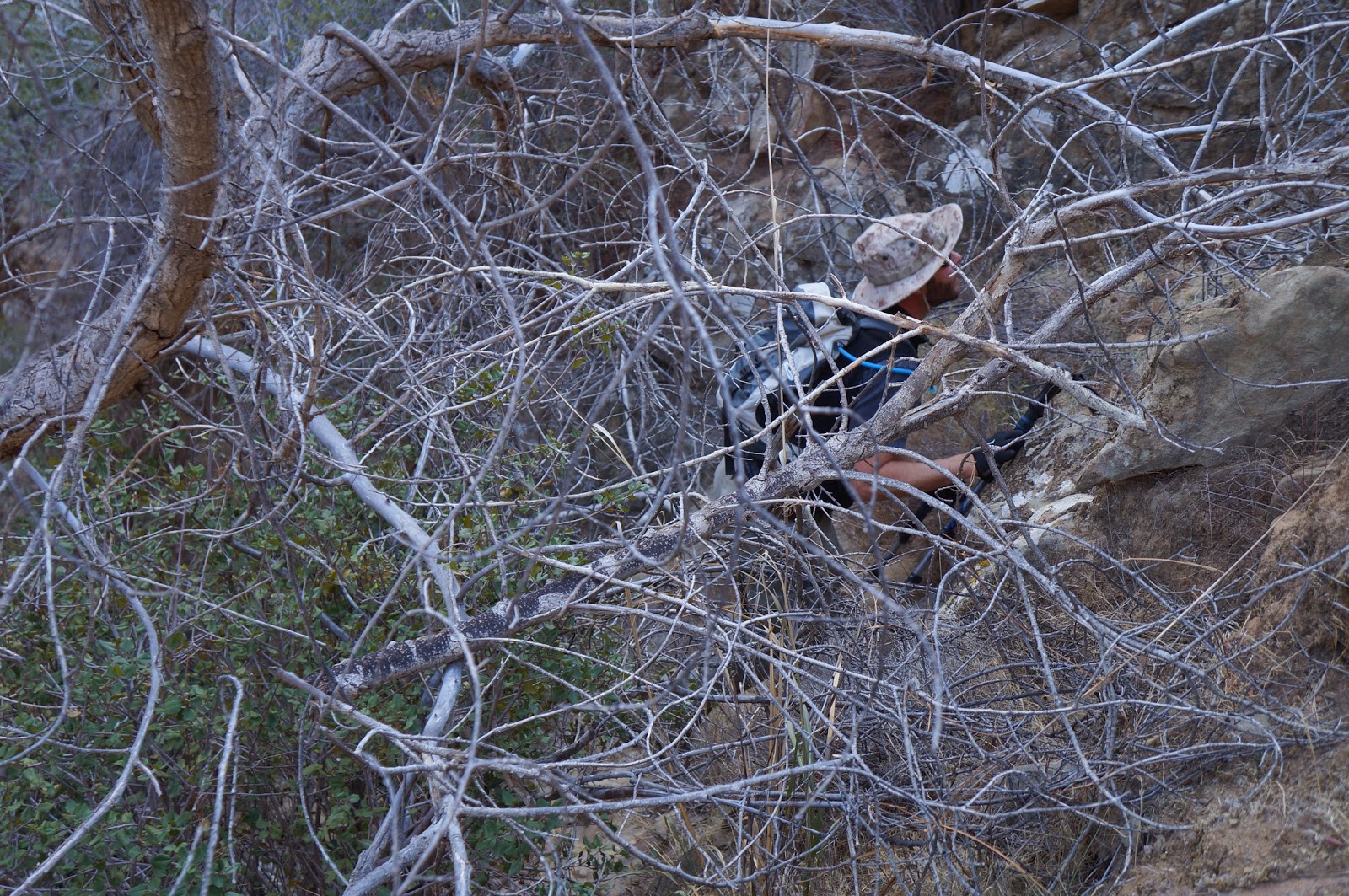
Jack and I got a good thrashing on the way up to the site, but not as severe as I had expected. On the way in we had to negotiate typical scrub conditions, lots of yucca (with its occasional "Ow! F*ck!"), plenty of spiky young manzanita (...more cursing), and several interesting geological obstacles. Eventually we entered a relatively recent burn area and things got a bit easier. Soon we had climbed into the right zip code and it was time to begin our search. 

Jack in the rocks.

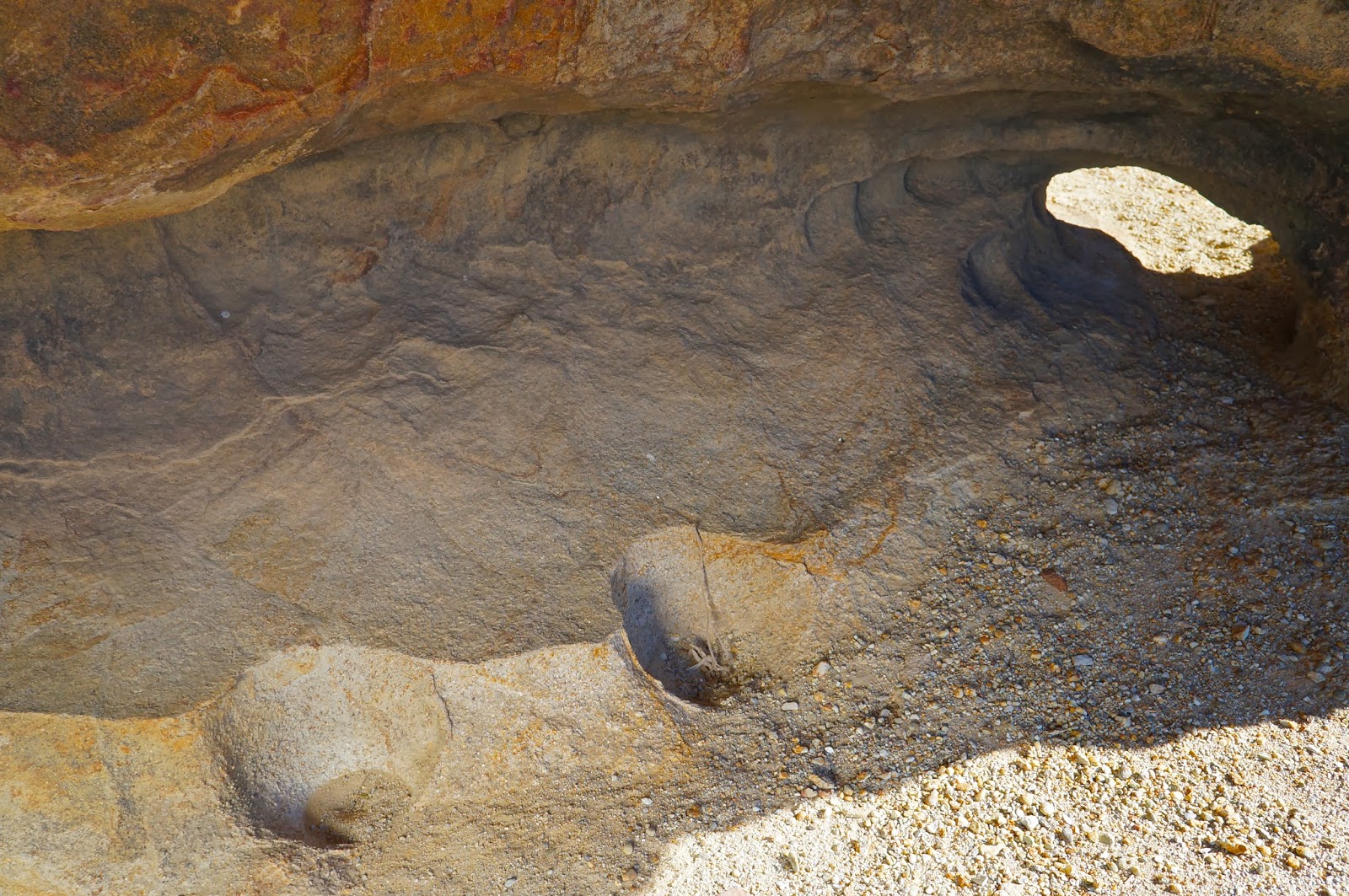
We started with a series of cave riddled sandstone formations on the western edge of our search area. At first we were disappointed to find that all of the pockets we were working were incredibly eroded. The rock was of such poor quality that floors of these caves were inches deep in fine sand. One could blow on this rock and watch it disintegrate. Jack and I split up and I found a series of wind caves that required some grit-sand climbing skills to get into. The floor of one such cave had a number of flat rocks on the floor which indicates a Chumash dry cache site. A dry cache is a cave or pocket, well off the ground, that usually requires some trickiness to reach. The Chumash would use these hard to reach pockets to store baskets or wraps with dry goods such as acorns, seeds, dried meat and other items. The point was to store these items in a place that rodents and other scavenging critters couldn't get to. Flat stones would be placed over these items to prevent them from suffering wind and rain damage, and to spare them from ravens and other birds. I have never found a dry cache with any artifacts in them, just the stones. When Jack and I linked back up he reported that he had also found a cache cave (we discovered a third cache later in the morning, photos below). Well, at least we were in the right neighborhood. We turned our search eastward, thoroughly scouring more sandstone stacks.

We found several water-channeled slots as we worked to the other side of our grid. Some of these were dangerously deep and contained tall drops. Hawk nests adorned the side walls of these mini gorges. Eventually, we stood on the rim of one such arroyo and as I peered at a single blob of sandstone a short distance away, something just clicked. Jack pointed out that the pockets in those small caves just across the way held some of the darker, browner type of stone that tends to hold up better over time, the type commonly associated with rock art. We wandered over for a look see and hit pay dirt.

The red sandstone pestle next to the BRM is not native to the immediate surroundings and was found exactly as shown. The other two stones showed signs of wear. We also found some fragments of brittle soapstone and a vein of highly crystalized quartz in the area.


This small site was unique in several ways. First, we found nine or so bedrock mortars, all highly eroded. The rims of several of these mortars had disintegrated entirely, leaving only shallow, half cups. Then there was the complete lack of any reliable water source any where in the vicinity, though the drainages I mentioned earlier had deep tanks which would have held rainwater for a time. Finally,  only a single pictograph adorned the site. Not even a fragment of any other art was visible. The first thing I thought when I saw this scrawling, red-lined picto was that I was looking at a map. Later I would compare it to a larger overview of the area using a topo map, and guess what? I still think its a map. The lines correspond very well with two major drainages and two of the outlying points are an almost exact fit with the two major Chumash sites I mentioned earlier, assuming that the primary center point of the pictograph represents "You are here.". I am 90% sure this pictograph is a simple line map. 


The third cache of the day. Note the flat stones that don't belong there. Three small man-made dishes in the soft sandstone aided in climbing up to the cache.

The cache above is the darker, left hand pocket.

For the sake of being thorough we continued through the rest of our self assigned search area but found nothing other than the third cache shown above. I did, however, notice a single set of scratch marks from an enormous bear. The claw lines were close to two inches apart. Eventually we had explored the entire area and decided there was nothing else to find. Time to turn it around and close the book on another interesting day in the Southern Los Padres.


Bear claw scratches.


Wednesday, December 25, 2013

Winter Solstice Site? "Expert" says no: Ferre Pedem Speluncam

Photo of this sun mandala taken Spring 2013
Having seen this particular pictograph in what I assumed was perpetual shade, you can imagine my surprise at learning that this painting is actually fully exposed to light for about one week per year, and that that only occurs during the week of the winter solstice (Which apparently does not make this site an "official" winter solstice sit, though obviously the timing of the sunlight on this pictograph is not coincidental. Please read comments below.). This was something I had to see for myself. To that end I met several good gentleman for a trip out to the site. In the late afternoon this "bullseye" of concentric rings was gradually revealed in the full light of the western sun. Pretty cool, but I'm kicking myself for not having brought a video setup. A time lapse clip would have been pretty neat. Maybe next year.


This shot was taken at around 14:45
at 15:20
at 15:45
and the following three were taken at 16:00


I also learned a few new things while out with these foul old dudes. For instance, in looking back through photos of mine taken at multiple sites there seems to be some truth to the theory that the "bullseye" mandalas only seem to crop up at sites that catch afternoon or sunset light (there is one exception that I've noted, but that mandala is attached to another element I call "the dark lord" and resides in year-round shade, to be found on the Carrizo). The flip side of that is that those sites that catch the morning sun tend to have mandalas formed around pointed star figures and have triangular rays somewhere in/or enclosing them. Looking at my own photos I smacked my forehead at the obvious truths of this revelation, truths which, it turns out, are possibly not so true. The person whose comments follow this post has insisted that he has all the answers and has invested a great deal of time  researching and promoting his theorie . If you're interested in learning more you can read the comments below and read his paper on the subject of solstice sites. I still say that the timing makes this bullseye a solstice phenomenon.

The image that I call "The Dark Lord" with a concentric ring sun mandala. There are a number of astronomy based elements at this Carrizo site including multiple "sunrise mandalas", half moons, star and planet designs, so it is pretty clear to me that this site had strong ties to the heavens.

An example of a "sunrise mandala" (and below). Both these paintings face east, the direction of the rising sun.

A half moon, star, and either a planet or full moon, from the same Carrizo site as the three preceding photos.

That's all I got today, and Merry Christmas.

Wednesday, November 20, 2013

Fresh Vandalism: Piedra Blanca Camp Pictographs


As disciplined as I'm trying to be about negative emotions and not saying things that imply judgement of others, some people just suck and deserve a brick to the head. While on an otherwise excellent day of rediscovering a long ignored friendship with Leo Genet (Asst. Scoutmaster Troop 302 Santa Paula) we ran into evidence of fresh vandalism to the pictographs at Piedra Blanca Camp. The upper image needs no explanation. The bottom image shows markings that indicate to me that this person or persons stood back and threw rocks at the art. I have a loose connection to the Site Monitor and sent him these images yesterday so he can report them to the appropriate authorities.


Sunday, July 21, 2013

A hot one on the Carrizo, 07/19/13


Some of you may have looked over my recent output and wondered "Where's the other Stillman? The one who hikes?". Believe me, I'm just waiting for rain (somewhat impatiently, I might add). I've got a helluva line-up planned for the fall/winter, and if I can accomplish just some of it you'll have been invited to some interesting and seldom seen country. In other words, when rain come the Stillman go. In the mean time I have (obviously) been spending a lot of time on rock art. What I would like to point out is that getting to these sites often takes more than a little effort, so rest assured I'm not just idling the summer by. Today for instance, I logged about 8 miles on foot in 103 degree heat. That's a bit like work.

My agenda for the day was to see another rock art site, an old ranch, and a couple spring sites. The old ranches of the Carrizo are fascinating places that really put you in the past and as for spring sites, some few have rock art, most do not. Sometimes the curious mind just has to go have a look see. Even if there's no rock art (likely), you may find a pretty place or something else that makes the looking worth the doing. At the minimum it becomes one less curiosity to be satisfied.


Today's rock art site is in a far corner of the Carrizo and required a good deal of cross-country rambling to find. Man, it was hot on the Plain. The air was still, without a breath of wind. Heat shimmers blurred the horizon and the sun cast Soda Lake in a stark glare of blinding white. El Sol beat down in a weird, almost heavy way, desaturating the sky with raw UV. By the time I located the alcove and it's impressive collection of rock art I was drenched head to toe in a dripping bath of my own salts (Sounds sexy, don't it? Not.). I was as grateful for the the alcove's cool shade as I'm sure the folks who painted these pretty pieces were. As with all things Carrizo, this site is pretty remarkable. After a cool down I got to work.


 As I said previously, the ranches of the Carrizo are well worth the time if rusting, falling down old things interest you. Traver Ranch, KCL Ranch, Saucito and others offer a stark look at the difficulties that the independent folks of that time would have lived with daily in order scratch out a living on the Plain. In this case, I found my way over to the Cochora Ranch site on the Elkhorn side of the Plain. This site started out with a natural spring which was developed further with a mill driven water well. A couple hundred yard away are several well shafts indicating the increasing demand for ground water as the area dried up. One old and battered wind mill still stands, rusting in peace. A small shed holds the next and final step in attempting to keep this ranch alive, a diesel engine driven jack pump. It appears that the ranch died a slow and parched death, and today the desert is reclaiming it's own.

Cochora Ranch

Diesel powered pump jack.


Evidence of life and death the Plain can be found with little effort.
I did quite a bit of driving around the Carrizo, criss-crossing the Plain a few times on old trails leading I knew not where. I ended up roving through a couple canyons, hiking into Lawson Spring and Padrones Spring. In this part of the Carrizo the hilly foothills of the Caliente Range descend to the valley floor, eroding into colorful badlands and washes. There is a collision of two or more types of rock at Padrones and if I knew anything about geology I could tell you more about that. 

Was a good day. Can't wait for things to cool down though. Stand fast, this too shall pass.

Padrones Spring
Link: Native American Art, My Perspective